RAG Is How You Stop Your AI From Hallucinating on Enterprise Data
RAG stops AI hallucination by grounding every answer in your actual documents with citations. See what a good RAG layer looks like and how to build one.
By Artificial Wit Team
By Artificial Wit Team. Last updated: July 4, 2026.
--- RAG for enterprise data means retrieving the actual source document before the model answers, then attaching a citation so a reviewer can verify it. That's the whole mechanism. Skip it, and you get a confident-sounding guess instead of a grounded answer, and the cost of that guess can be higher than most teams expect.
In 2025, Deloitte's Australian arm delivered a $290,000 report to the country's Department of Employment and Workplace Relations. It was an independent review of an automated welfare compliance system. A Sydney University researcher found the report was riddled with fabricated citations: references to academic papers that don't exist, and a quote wrongly attributed to a federal court judge. Deloitte had used a generative AI model to help draft it, without grounding its output in real sources. The firm had to refund part of the fee (Fortune, October 2025). The content read as authoritative. None of it was checked against an actual source before it shipped.
That's the gap RAG closes. This guide covers what a good enterprise RAG layer actually looks like, how permission-aware retrieval protects sensitive data, when RAG is the right tool versus fine-tuning, and how to roll one out without a multi-month project.
- RAG stops hallucination by retrieving a real source document before the model generates an answer, then attaching a citation for verification.
- A real 2025 incident: Deloitte Australia refunded part of a $290,000 government report after it was found to contain AI-fabricated citations and a fake judicial quote, a direct consequence of ungrounded AI output.
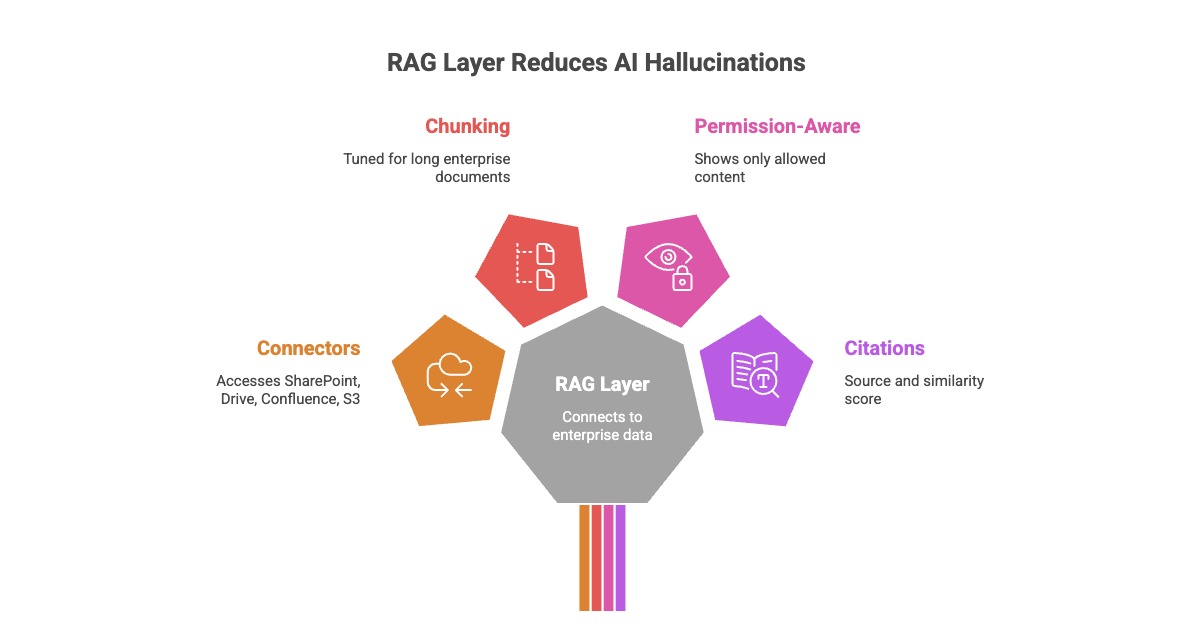
- A good enterprise RAG layer needs four things: connectors to real sources, chunking tuned for long documents, permission-aware retrieval, and citations on every answer.
- RAG and fine-tuning solve different problems, RAG for grounding answers in current, verifiable data, fine-tuning for changing how a model behaves or writes.
- Permission-aware retrieval means the AI only returns what the requesting user is already authorized to see, the same access control already applied to human employees.
What is RAG, and why does it stop hallucinations?
RAG is a technique that retrieves relevant documents from a knowledge base before an AI model generates its answer. It then asks the model to answer using only what it retrieved, with a citation back to the source. The alternative is relying on whatever the model memorized during training, which is often outdated or simply wrong for company-specific data. RAG answers from a real document you can check instead.
Ask a vanilla LLM about your renewal terms or last quarter's numbers, and it will guess, confidently. It has no access to your actual contracts or financials, so it produces something plausible-sounding instead. RAG fixes that by making the retrieval step mandatory: no source document, no answer, or at minimum, an answer that's clearly flagged as unsupported.
What a good enterprise RAG layer actually looks like
Not all RAG implementations are equal, and the difference between a good one and a bad one usually comes down to four things.
Connectors for the sources that actually matter
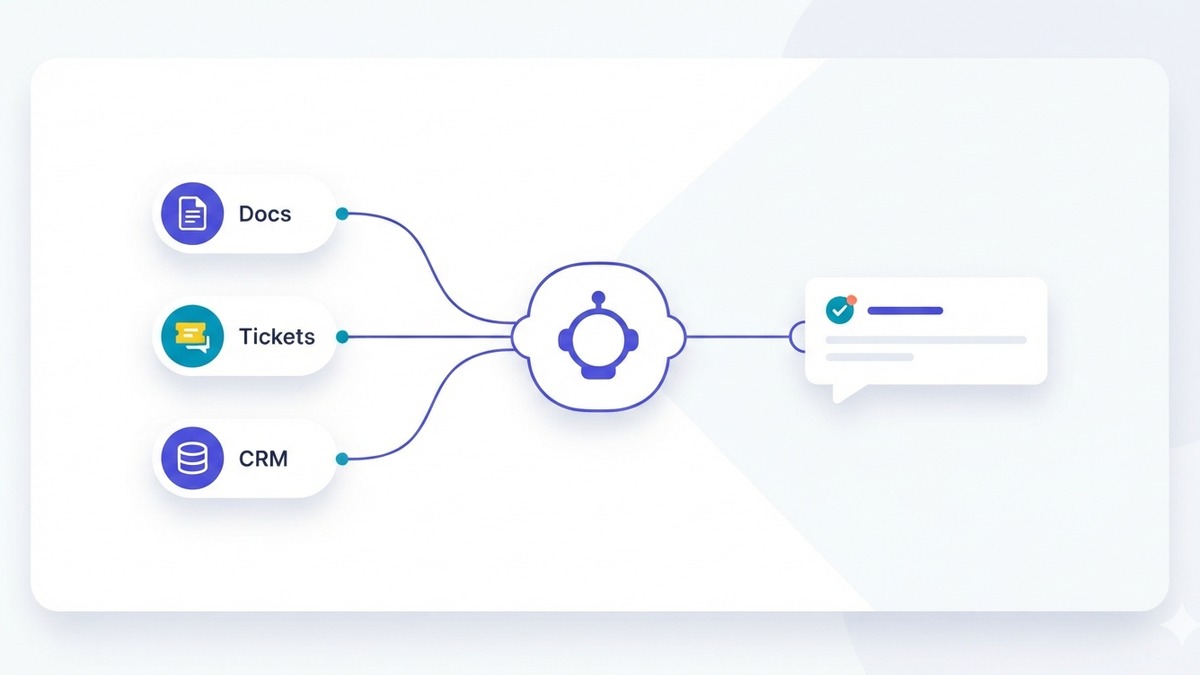
A knowledge base is only useful if it connects to where your documents actually live: SharePoint, Confluence, Google Drive, S3, internal databases. Generic file upload isn't enough for most enterprises, since the documents that matter are usually scattered across three or four systems, not sitting in a folder waiting to be manually uploaded.
David ran support operations for a B2B software company where the answer to almost any customer question lived somewhere: a Confluence runbook, a Google Doc pricing exception list, a Salesforce case history. His team's first knowledge base pilot only indexed the Confluence space, and it answered maybe half of what agents actually asked. Once Drive and Salesforce were connected too, the same assistant started resolving tickets on the first reply instead of the second, simply because it could finally see where the real answer lived.
Chunking and embeddings tuned for long documents
Enterprise documents, contracts, SOPs, compliance manuals, are often dozens of pages long. Splitting them into chunks that are too large returns irrelevant context; too small, and you lose the surrounding meaning a clause depends on. Getting this tuning right is what separates a RAG layer that retrieves the right paragraph from one that retrieves something adjacent to it.
Permission-aware retrieval
This is the one teams skip most often, and it's the one that turns into a security incident if skipped. Retrieval needs to respect who's asking, not just what's being asked. A support agent's AI assistant shouldn't surface a document from the executive team's restricted folder just because it's the closest semantic match.
Citations on every answer
Every answer should come back with the source document, a similarity score, and a reference a reviewer can check. This is the mechanism that would have caught the Deloitte report before it shipped: a citation pointing to a real, retrievable source, or no citation and a flagged, unverified answer.
This habit pays off outside the chat window too. As more buyers ask ChatGPT or Perplexity to research vendors before they research your website directly, a knowledge base built around citations and verifiable answers is also the one most likely to get quoted accurately by those tools. Grounding isn't just an internal safeguard, it's what makes your content trustworthy enough for other AI systems to cite in the first place.
RAG vs. fine-tuning: which should you use?
These solve different problems, and enterprises often reach for the wrong one.
| RAG | Fine-tuning | |
|---|---|---|
| Best for | Grounding answers in current, verifiable documents | Changing how a model writes, reasons, or follows a format |
| Data freshness | Updates as soon as new documents are ingested | Requires retraining to reflect new information |
| Verifiability | Every answer traces to a source document | No inherent citation mechanism |
| Typical use case | "What does our contract say about X" | "Always respond in this tone or structure" |
Most enterprise hallucination problems are RAG problems, not fine-tuning problems. If the issue is the model inventing facts about your business, grounding it in real documents solves that directly. Fine-tuning changes behavior, not truthfulness, and won't stop a model from confidently citing a paper that doesn't exist.
In practice, many teams use both together, and that's fine. Fine-tuning might teach a support assistant to always respond in a specific tone or to format answers a certain way. RAG is what makes the content of that answer correct. Skipping RAG because you've already fine-tuned a model is a common mistake, since fine-tuning does nothing to stop the model from inventing a policy detail it was never trained on.
How permission-aware retrieval protects sensitive data
Elena managed compliance documentation for a mid-size insurer, and one of her first questions when evaluating an AI knowledge base tool was blunt: "if I ask it something, can it accidentally show me a document I'm not supposed to see?" It's the right question. A knowledge base that ignores existing access controls turns a helpful assistant into a data exposure risk the moment someone asks a question whose best semantic match lives in a restricted folder.
Permission-aware retrieval solves this by checking the requesting user's actual access rights before returning a result, not just running a similarity search against the entire index. The AI only sees, and returns, what the human asking is already cleared to see. That's not a new governance model. It's the same one your document management system already enforces, applied consistently to the AI layer instead of stopping short of it.
For compliance and legal teams specifically, this matters twice over. First, the obvious reason: nobody wants an AI assistant leaking a restricted contract to someone outside the deal team. Second, a less obvious one: a permission-aware system produces a clean audit trail of who asked what and which documents backed the answer. When a regulator or an internal auditor asks how a decision was made, "the AI said so" isn't an answer. A citation to a specific, access-controlled document is.
Rolling out RAG without boiling the ocean
You don't need to index your entire document estate on day one to get real value.
- Start with one high-friction question. Pick a question your team answers manually and often, contract terms, policy exceptions, product specs.
- Connect the two or three sources that actually contain the answer, not every system you have.
- Tune chunking for your document length. Long contracts and short FAQs need different chunk sizes; don't use one setting for both.
- Apply permission-aware retrieval from day one. Retrofitting access control after a knowledge base is live is harder than building it in from the start.
- Require citations on every answer, and treat an uncited response as a signal to check the retrieval step, not a fluke.
Artificial Wit AI ships this as a managed Knowledge Base: connect your sources, and every answer comes back with a source document, similarity score, and reference number attached, no separate citation system to build.
Pair a grounded answer with a registered tool call, and the result doesn't have to stay a paragraph of cited text. It can render as a live artifact, a table or dashboard Claude generates on the spot from the tool's own input schema, with the same citations attached.
Want to see grounded answers working on your own documents? Sign up free and connect your first source to get a cited, grounded assistant running today.
Frequently asked questions about RAG and enterprise data
What is RAG and how does it reduce hallucinations? RAG retrieves an actual source document before the AI generates its answer, then requires the answer to cite that source. Instead of the model guessing from memorized training data, it answers from something verifiable.
How is a "second brain" different from a regular knowledge base? The terms describe similar systems, but a well-built one is permission-aware and cites its sources on every answer, not just a searchable document repository.
Can RAG respect existing document permissions? Yes, when it's built with permission-aware retrieval. The system checks the requesting user's access rights before returning results, so it only surfaces documents that person is already authorized to see.
What's the difference between RAG and just uploading files to ChatGPT? Uploading files to a general chat tool typically lacks permission-aware retrieval, citation tracking, and tuning for long enterprise documents. A proper RAG layer is built to verify and govern answers, not just add context to a single conversation.
Do enterprises actually get burned by skipping this? Yes. Deloitte Australia's 2025 refund of part of a $290,000 government report, after it was found to contain AI-fabricated citations, is a documented example of exactly what ungrounded AI output costs when it ships unchecked.
The bottom line
Retrieval-Augmented Generation isn't a buzzword, it's the difference between an assistant that quotes your actual documents and one that invents something plausible-sounding in their place. The Deloitte case shows what that difference costs when it goes wrong: a six-figure refund and a public correction. Connect the sources that matter, tune retrieval for your documents, respect existing permissions, and require a citation on every answer, and you get a grounded assistant instead of a liability.
Sign up free and connect your first source → No credit card required, get a grounded, cited assistant running on your own documents today.
Related reading
Ready to put this into practice?
Talk to us about your stack